MAC
The main responsibilities of the MAC are:
- Encoding and decoding of MAC PDUs sent and received over the FAPI interface.
- Scheduling of DL/UL grants for System Information, Paging, UE data (RLC PDUs + MAC CEs) and Random Access, via the embedded gNB scheduler.
- Demultiplexing and forwarding of decoded MAC Rx SDUs to their respective logical channels.
- Handling of received MAC CEs.
- PRACH handling and RNTI allocation.
Architecture
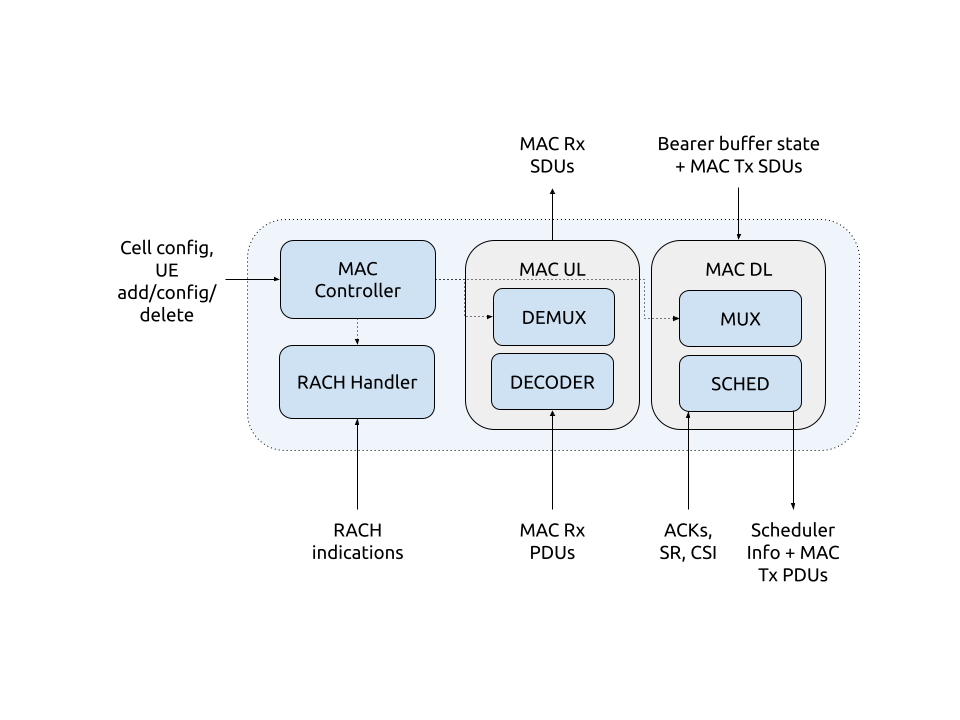
The MAC interacts with FAPI, the RLC and the DU control plane. It is built from the sub-components shown above and
exposes its functionality through abstract C++ interfaces (include/ocudu/mac/); the top-level mac interface
(mac.h) hands out the per-cell and global handlers via accessors such as get_slot_handler(), get_pdu_handler(),
get_cell_manager() and get_ue_configurator(). The three peers map onto the figure's edges: the DU control plane
configures the MAC, SDUs are exchanged with the RLC, and PDUs are exchanged over FAPI.
Sub-components
- MAC Controller (
mac_controller) — translates DU configuration requests (add cell, add/reconfigure/remove UE) into commands for the other sub-components, applying them with minimal service disruption and without races (see Configuration Lifecycle). - RACH Handler (
rach_handler) — allocates RNTIs for received PRACH preambles and associates each RNTI with a DU UE index (see RNTI Management). - MAC UL Processor (
mac_ul_processor) — decodes received MAC PDUs and demultiplexes the SDUs and MAC CEs (see UL Data Path). - MAC DL Processor (
mac_dl_processor) — drives the scheduler and assembles the DL MAC PDUs (see DL Data Path and Scheduler).
DU control plane interface
Configuration and UE lifecycle events, driven by the DU manager:
- Configuration —
mac_cell_manager(add_cell/remove_cell, plus per-cellstart/stop/reconfigure) andmac_ue_configurator(handle_ue_create_request/..._reconfiguration_request/..._delete_request, returned asasync_tasks). - UL-CCCH / contention resolution —
mac_ul_ccch_notifier(on_ul_ccch_msg_received,on_crnti_ce_received) reports a received Msg3 to the upper layers, triggering UE creation in the DU.
RLC interface
User-plane SDUs, one bearer per logical channel, bound through mac_logical_channel_config:
- Input (from RLC): a
mac_sdu_tx_buildersupplies DL SDUs (on_new_tx_sdu) for DL PDU assembly and RLC bearer's buffer occupancy reports (on_buffer_state_update), which the MAC forwards to the scheduler, and - Output (to RLC): a
mac_sdu_rx_notifier(on_new_sdu) which the MAC uses to forward decoded UL SDUs to the RLC.
FAPI interface
The MAC's lower-edge handlers are translated to and from real FAPI messages by the FAPI adaptor, which lives outside
lib/mac, so the MAC is written purely against these abstract handlers.
Inputs (from FAPI):
mac_cell_slot_handler— delivers the per-slot timing trigger (handle_slot_indication) that drives scheduling and the generation of the slot's DL/UL results; also surfaces lower-layer processing errors (handle_error_indication) and the completion of a cell stop (handle_stop_indication).mac_cell_rach_handler— delivers the PRACH preambles detected by L1 (handle_rach_indication), starting the Random Access procedure.mac_cell_control_information_handler— delivers the UL control feedback decoded by L1 and forwards it to the scheduler: PUSCH decode results (handle_crc), PUCCH/PUSCH UCI carrying SR, HARQ-ACK and CSI (handle_uci), and SRS channel reports (handle_srs).mac_pdu_handler— delivers the decoded UL MAC PDUs (handle_rx_data_indication) for decoding and demultiplexing in the UL data path.
Outputs (to FAPI): the MAC pushes each slot's results back through mac_cell_result_notifier (obtained from
mac_result_notifier::get_cell):
on_new_downlink_scheduler_results— the DL scheduling decisions (encoded PDCCH DCIs, SSB and PDSCH allocations), i.e. theDL_TTI.request.on_new_downlink_data— the assembled DL MAC PDU payloads (SI, RAR, paging, UE DL-SCH), i.e. theTx_Data.request.on_new_uplink_scheduler_results— the UL grants (PUSCH/PUCCH), i.e. theUL_TTI.request.on_cell_results_completion— the end-of-slot sentinel signalling that all results for the slot have been delivered.
Concurrency and Parallelism
The MAC does not own any threads of its own. Instead, every MAC task runs on a task_executor provided at construction
time, and the mapping of tasks to executors is what determines the MAC's concurrency model. This lets the same MAC code
run single-threaded in tests and simulators, or spread across a worker pool in a real-time deployment, just by swapping
the executor mapper.
Executors are supplied to the MAC through mac_config as three handles:
ctrl_exec— a single, DU-wide control executor.cell_exec_mapper(mac_cell_executor_mapper) — per-cell executors.ue_exec_mapper(mac_ue_executor_mapper) — per-UE executors.
External events and thread-safety
The MAC's public entry points are invoked from threads it does not control: slot indications, RACH indications, CRC/UCI/SRS indications and received PDUs all arrive on FAPI threads, while configuration requests arrive on the DU manager's thread. These callers touch no MAC or scheduler state directly. Each entry point either:
- dispatches the event onto a MAC executor — e.g. the slot indication is enqueued onto the cell's
slot_ind_executorand received UL PDUs onto the UE'smac_ul_pdu_executor— so that the actual handling runs serialized on the owning strand; or - forwards the event to the scheduler, which manages its own thread-safety internally. CRC, UCI, SRS and error
indications are passed straight into the scheduler from the calling thread; the scheduler buffers them in its own
thread-safe queues and applies them later, in the cell's
slot_indication()context.
This is the central invariant of the MAC's concurrency model: any state mutation must reach the owning strand (or the scheduler's internal queues) before it touches shared state. A new entry point that reads or writes MAC/scheduler state inline on the caller's thread, instead of hopping onto the appropriate executor or deferring to the scheduler, introduces a data race.
Serialization vs. parallelism
The MAC relies on strands (see support/executors/strand_executor.h) rather than locks to keep shared state
consistent. A strand guarantees that tasks dispatched to it run one-at-a-time, in a serialized fashion, even when the
strand is backed by a multi-threaded worker pool. Parallelism is therefore achieved between strands, not within one:
tasks on different strands may run on different workers concurrently, while tasks on the same strand never overlap.
This yields three independent axes of parallelism:
- Across cells — each cell has its own strand, so different cells schedule and assemble their DL/UL grants in parallel.
- Across UEs — UEs are distributed over a bounded set of strands, so UL PDU processing for different UEs can proceed concurrently.
- Control vs. data — control-plane reconfiguration is funnelled onto its own serialized executor, decoupled from the per-cell real-time path.
Conversely, work that must not race is forced onto the same strand and thus serialized.
Per-cell execution
Each cell exposes two executors via the mac_cell_executor_mapper:
slot_ind_executor(cell)— high-priority path for the periodic slot indication coming from FAPI.mac_cell_executor(cell)— default path for other, non-slot cell tasks.
The slot indication is the heartbeat of the cell: mac_cell_processor::handle_slot_indication() merely enqueues onto
slot_ind_executor, and the actual work — invoking the scheduler for that cell, assembling the DL/UL PDUs, and
forwarding the result to FAPI — runs in that executor's context. The scheduler therefore has no executor of its own; it
is driven synchronously, once per cell per slot, on the cell strand. Because each cell uses a distinct strand,
scheduling for different cells runs in parallel, while everything within a single cell is serialized.
The cell executors can be configured two ways (du_high_executor_config::cell_executor_config):
- Dedicated worker per cell — each cell gets its own thread, fully isolating cells.
- Strand-based worker pool — one strand per cell, all sharing a common worker pool. Slot indications use a higher strand priority than other cell tasks so they are never starved by lower-priority work.
Per-UE execution
UE-specific work runs on the mac_ue_executor_mapper:
ctrl_executor(ue)— UE state changes (creation, reconfiguration, removal); infrequent.mac_ul_pdu_executor(ue)— decoding of received MAC PDUs and demultiplexing of UL SDUs.
UEs are mapped onto a bounded pool of strands (policy per_cell or round_robin, capped by max_nof_strands), trading
off parallelism against memory. Within a UE's strand, control tasks take priority over UL PDU handling, which in turn
takes priority over DL PDU handling. Two UEs on different strands process their UL PDUs concurrently; two UEs sharing a
strand are serialized.
Control-plane serialization
Configuration requests from the DU manager (add cell, add/reconfigure/remove UE) are handled by the MAC Controller
on the single DU-wide ctrl_exec, which is a serialized strand. Routing all reconfiguration through one strand is what
lets the MAC Controller apply changes without locks and without racing against the per-cell real-time path — it hands
off to and from the cell executors at well-defined points (e.g. cell activation/deactivation) rather than mutating cell
state directly.
Summary
| Task | Executor | Scope | Serialized within | Runs in parallel across |
|---|---|---|---|---|
| Slot indication, scheduling, DL PDU assembly | slot_ind_executor | per cell | a cell | cells |
| Other cell tasks (lower priority) | mac_cell_executor | per cell | a cell | cells |
| UL PDU decode / demux | mac_ul_pdu_executor | per UE | a UE's strand | UEs on different strands |
| UE control (add/reconfig/remove) | ctrl_executor | per UE | a UE's strand | UEs on different strands |
| MAC configuration (cells, UEs) | ctrl_exec | DU-wide | the whole MAC | nothing (fully serialized) |
DL Data Path
The DL path is driven by the per-cell slot indication. mac_cell_processor::handle_slot_indication_impl() runs once per
cell per slot and:
- Invokes the scheduler for that cell, obtaining a
sched_result. assemble_dl_sched_request()builds themac_dl_sched_result— SSB (ssb_helper) and the encoded PDCCH DCIs (encode_dci) — and forwards it to FAPI viaon_new_downlink_scheduler_results.assemble_dl_data_request()builds themac_dl_data_result, i.e. the actual MAC PDU payloads, and forwards it viaon_new_downlink_data:- SIB / broadcast via
sib_pdu_assembler, - RAR via
rar_pdu_assembler, - UE DL-SCH via
dl_sch_pdu_assembler, - paging via
paging_pdu_assembler.
- SIB / broadcast via
- UL grants are forwarded via
on_new_uplink_scheduler_results, andon_cell_results_completioncloses the slot.
DL-SCH assembly (dl_sch_pdu_assembler::assemble_newtx_pdu) allocates a HARQ buffer and, for each scheduled logical
channel, pulls SDUs from RLC (mac_sdu_tx_builder::on_new_tx_sdu) and encodes the subheader and payload; MAC CEs such
as the UE Contention Resolution Identity and Timing Advance Command are multiplexed in, and the transport block is
padded out. Retransmissions (assemble_retx_pdu) reuse the cached HARQ buffer rather than re-fetching SDUs. Once
results are handed to FAPI, update_logical_channel_dl_buffer_states() reads the new RLC buffer state
(on_buffer_state_update) and feeds it back to the scheduler (handle_dl_buffer_state_update).
UL Data Path
Received PDUs enter through mac_pdu_handler::handle_rx_data_indication() (mac_ul_processor). For each PDU the UE is
resolved through the RNTI table and the work is dispatched onto that UE's mac_ul_pdu_executor, where
pdu_rx_handler::handle_rx_pdu() runs:
- The UL-SCH PDU is unpacked into subPDUs (
mac_ul_sch_pdu::unpack). - SDUs are forwarded to the logical channel's RLC bearer (
mac_sdu_rx_notifier::on_new_sdu). - MAC CEs are parsed and forwarded: BSR via
handle_ul_bsr_indication, PHR viahandle_ul_phr_indication, both consumed by the scheduler. - CCCH (Msg3 / SRB0) — when no UE exists yet for the TC-RNTI, the UL-CCCH message is delivered to upper layers via
mac_ul_ccch_notifier::on_ul_ccch_msg_received; the SDU itself is pushed once the DU has created the UE (push_ul_ccch_msg). - C-RNTI CE —
handle_crnti_ce()resolves the existing UE for the carried C-RNTI, re-dispatches the remaining subPDUs onto that UE's executor, and notifies both the scheduler (handle_crnti_ce_indication) and upper layers (on_crnti_ce_received) for contention resolution.
Scheduler
The MAC contains the gNB scheduler but treats it as a self-contained subsystem behind ocudu_scheduler_adapter
(implementing mac_scheduler_adapter). The MAC pushes events to the scheduler — rach_indication, CRC/UCI/SRS,
BSR/PHR, DL buffer state, and UE add/reconfigure/remove — and queries it once per cell per slot through
slot_indication(), whose returned sched_result drives the DL data path above. As described under Concurrency, the
scheduler manages its own thread-safety for indication ingest. Its internal design is documented separately in
lib/scheduler/README.md.
Configuration Lifecycle
Configuration is handled by the MAC Controller (mac_controller) running on ctrl_exec. Adding a cell registers it
with the timing source, metrics, scheduler and DL handler. Cell removal unwinds these steps in reverse order. The MAC
cell start/stop controls the scheduler cell activation/deactivation.
UE add, reconfigure and remove are asynchronous procedures (ue_creation_procedure, ue_reconfiguration_procedure,
mac_ue_removal_procedure) implemented as coroutines that hop between the control executor and the per-cell/per-UE
executors, setting up or tearing down the DL and UL contexts. These operations dispatched to the per-cell/per-UE
executors should be latency bounded, so that other latency-sensitive tasks running in these executors do not get
affected.
UE creation in the MAC and in the DU as a whole is deferred until Msg3 (see the RA Procedure). Removal deletes the scheduler context first — so no further grants are produced — then the UL/DL contexts, and finally the controller's UE entry.
RNTI Management
rnti_manager allocates a TC-RNTI for each detected contention-based PRACH preamble and C-RNTIs for UEs created from
upper layer procedures (e.g. F1AP UE Context Setup Request). The rnti_value_table maps RNTI ↔ du_ue_index in a
lock-free manner.
Radio Link Failure Detection
The rlf_detector (owned by the scheduler adapter) tracks three per-UE atomic counters: consecutive DL KOs (HARQ-ACK
NACK/DTX), UL KOs (PUSCH CRC failures) and undecoded CSI (DTX). The thresholds come from mac_expert_cell_config
(max_consecutive_dl_kos, max_consecutive_ul_kos, max_consecutive_csi_dtx, default 100).
handle_ack/handle_crc/handle_csi — driven from the UCI decoder and CRC handler — reset the relevant counter on
success and increment it on failure; the first time a counter reaches its threshold, an RLF is reported to the DU
manager via mac_ue_radio_link_notifier::on_rlf_detected, deferred onto ctrl_exec. A received C-RNTI MAC CE resets
all counters and invokes on_crnti_ce_received, cancelling a spurious RLF once the UE re-synchronises.
Procedures
Step-by-step descriptions of the MAC's runtime procedures (e.g. Random Access) are documented separately in
procedures.md.